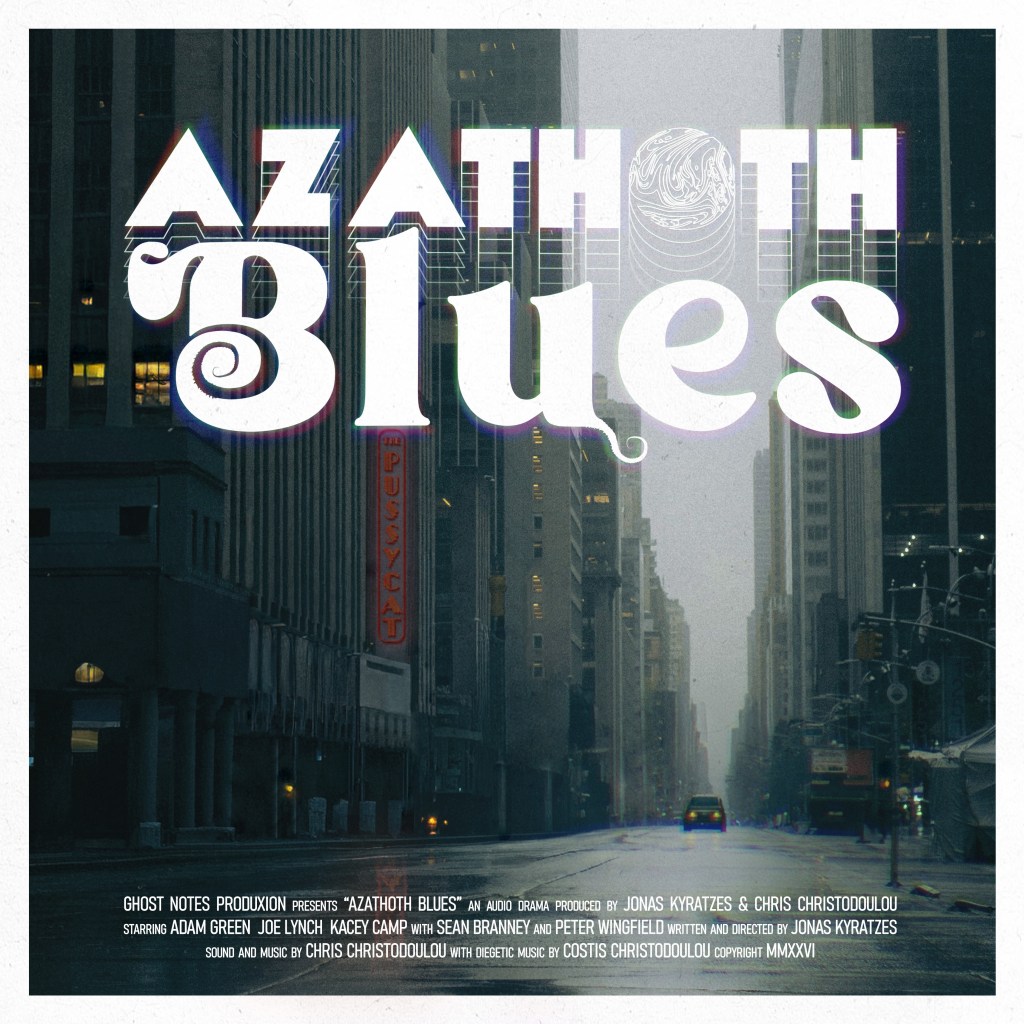
Episodes 2 and 3 of Azathoth Blues are now available on all podcasting platforms.
There are probably some of you who are holding back from checking out Azathoth Blues because it’s not a videogame. That’s something that happens a lot nowadays – we’re all encouraged to stay in our familiar little boxes, to only repeat experiences we’ve already had.
Consume the same product over and over. Define yourself by the fact that you are a consumer of this product. Get angry if the product changes.
But we don’t have to think in this dehumanized way that reduces us to functions of the market.
If you liked the humanism of The Talos Principle, the performances of the actors in Clash: Artifacts of Chaos, or the prose of the The Sea Will Claim Everything – if you enjoyed any of the qualities that I bring to the stories I write, then please do me a favour and check out this show. Even if you’ve never listened to an audio drama before. If you don’t know anything about H.P. Lovecraft or think he’s some kind of printer and/or sauce. Even if you hate stories about the police. Because I’ve poured everything I had into it, everything that made you appreciate those other stories in other media – and we released it entirely for free.
It’s not a product. It’s art, made solely out of love. I know that to say something like that so sincerely is gauche, it’s “cringe” as the irony-poisoned youngest generation likes to say, but it’s also true. It’s art, serious art, made at a high level of quality and ability, because that’s a beautiful thing, a thing that matters, and dedicating time and effort to it is meaningful.
And if you end up liking the show, please take a moment to leave a review or a rating, or to tell someone about it. Things made out of love don’t stand much of a chance nowadays, but you can help them survive the avalanche of slop that our culture is drowning in.
If you have liked anything I’ve ever made, please check this out. And if you like what you hear, please rate it, review it, and help us spread the word. Independent art can’t survive without a passionate audience that champions it.
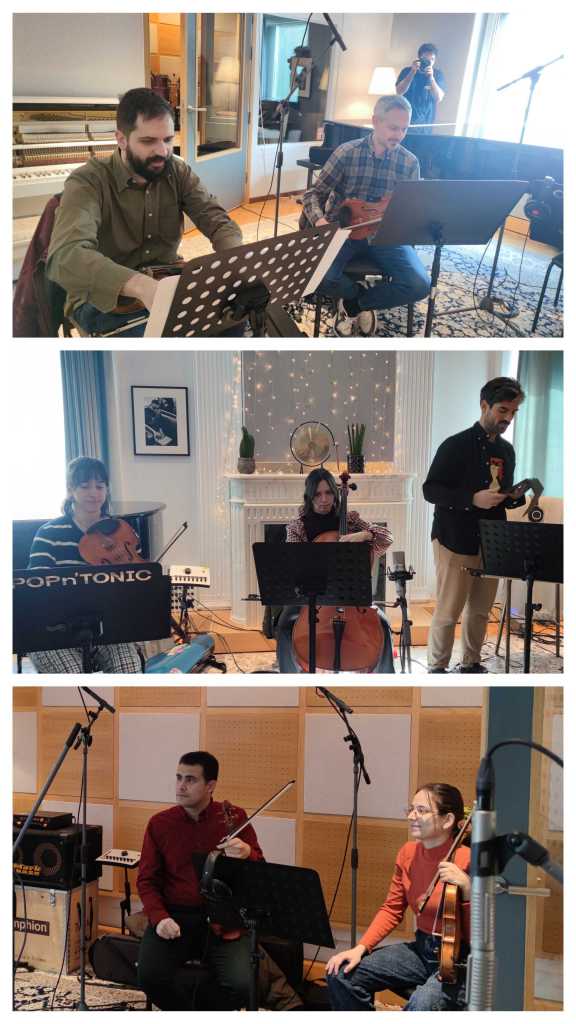
These photos are from a recording session for Azathoth Blues, our upcoming cosmic horror podcast. Chris collaborated with the De Profundis Ensemble to create some genuinely stunning recordings… which are just one small element of the show’s wider soundscape.
I, meanwhile, travelled to Los Angeles, where the three leads and I worked in a studio for days, recording the episodes together in chronological sequence. (More about our process soon.) Then I also recorded in other studios, both physically and digitally, to put together just the right cast of actors for these gritty, fucked-up, but very human characters.
Even that is just a fraction of the effort and money that went into making Azathoth Blues. We took this very seriously. This show dwarfs many a corporate production.
And we’re releasing it for free. Without ads.
Why on Earth would we do that?
Here’s how I see it. Chris and I believe in making art. Our belief in this is akin to a religious belief, absolutely fundamental to who we are and how we see the world. We don’t make #content. We don’t grind or hustle or whatever the latest pseudo-edgy terminology is. We are not trying to serve the market, as artists are often advised to do.
It’s not that we’re opposed to making money. Or that we don’t claim ownership of our art. We’re not making moral claims about the act of selling something. We will happily make things and sell them, as you have to do to survive in this system. (That a different system might be better is a different story.) But the degree to which a commercial mentality has penetrated every single aspect of art these days is absolutely deplorable.
Since we’re dealing with an audio drama, take ads. The way every single podcast gets infected with them, until at some point the podcast itself seems so secondary to the ads that its audience abandons it, a host killed by a parasite. It’s awful, isn’t it, seeing it happen?
Even worse: ad reads. When people whose voices you used to enjoy are used to lure you into buying absolute garbage. And you know they know it’s garbage. Hey guys! I used to have constant problems with belly button fluff until my friend recommended Denavelex. With Denavalex, I never have to worry about bits of lint embarrassing me when I have friends over for belly dancing competitions, and it only costs $199.99 with a yearly subscription!
Is it better if the hosts sound pained and embarrassed reading that vile nonsense, or do you prefer it when they pretend to love it? Degradation or hypocrisy?
The only correct answer is: neither, please.
We are drowning in an ocean of absolute slop, and I don’t just mean AI-generated stuff. I mean the generic content, made without care, without serious artistic ambition, and aimed solely at an audience of illiterate children. That’s how the people who own everything think of you: stupid, childish, easily manipulated, lacking any serious desire to be more or understand more.
But beyond the corporate slop, I also mean the stuff that started with nobler intentions but slowly degenerated into slop due to the logic of having to serve the market, having to sell more ads. Or due to artists thinking they have to please the loudest voices. I won’t name the shows that I loved, that I thought were truly remarkable works of art, but which became shallow self-parodies by the end, a nightmarish alteration of increasingly narcissistic fan service and supplements, socks, and therapy hotlines. I’m sure you have your own examples.
People have truly profound experiences listening to our previous show, Gospels of the Flood. That means a lot to me, because my soul is in that story, and I know both Chris and Peter invested so much of themselves in it, too. But it’s a fragile experience. It’s the words and the music and Peter’s voice. Imagine if it stopped to sell you a product. All of that work would be for nothing.
I mean, this being the internet of today, in a self-cannibalizing fully financialized system, of course someone somewhere will try to insert ads. That sucks. But it’s the intent I’m speaking about. It’s not even the ads themselves that matter. That art will function as a product in some conditions is a given. But to create it with that intent, to have the logic of commerce in your mind during the creative process, is to me a true perversion, a sin.
I’ve used a heavy word there, and I realize how easy it is for this to become a kind of moralistic pose that does not acknowledge the reality of working in this system, or that mistakenly preaches some kind of “dropping out” of capitalism. That’s not the point. I’m not trying to preach moral superiority. But at the same time, I’m not willing to mince words and pretend that I think the arts are in a healthy place right now.
We will, in time, have to offer people ways of giving us money so we can make more Azathoth Blues. I’ve been meaning to put up a Patreon for myself, there may be a Kickstarter, there may be ways of purchasing the show in various formats, etc. But for me, there need to be certain limits. There needs to be a willingness to assert that not every single crevice of our lives should be invaded by financial considerations.
There is a whole other conversation to be had about various ways of selling things in the digital age, and whether there even is any model that still makes sense. Those are bigger, more abstract and more political discussions. But on a visceral level, for me as an artist making this enormous thing that means so much to me, it’s increasingly evident that we have to find ways of doing this without compromising the art itself. We have to make a living, but there are compromises that we must reject.
And so Azathoth Blues is ad-free, and hopefully you’ll enjoy it and help us make more art in the future.
Azathoth Blues is an incredibly important project for me – I’ll be writing a lot about it in the coming weeks. It’s a huge undertaking that took enormous effort to get off the ground, and it’s going to be entirely ad-free. So we’ll need all the support we can get!
Check out the trailer above, and visit the official website. More soon!
Recently I was reminiscing about a foundational experience of my life as a game developer. I don’t know how old I was, but I’m guessing it was somewhere between 11 and 13. My family did not have a PC yet, but we had a Sega Mega Drive, relatively recently purchased. I also had a Gameboy, which had already provided some life-changing experiences (Metroid II and Link’s Awakening), and a Sega Master System, which had some memorable games but never quite what I was longing for.
There had been a moment of agonizing about whether to get a SNES or a Mega Drive (aka Genesis) – and writing this, I just realized that the agony of this dilemma has caused the location of the shop where my dad bought me the console to be imprinted on my brain. It was in Kalamaria, near my orthodontist who gradually went from very attentive to letting his less skillful assistant/wife do everything, until one day we stopped going and my teeth never got fixed. And now I’m remembering the time the assistant/wife accidentally broke my braces, and the weird sensation of that stuff they put in your mouth to take a mould. Memory’s funny that way.
Anyway, there was a shop not too far from where we lived, maybe twenty minutes away, on a street called Anatolikis Thrakis (Eastern Thrace Street), near where I would later have Tae Kwon Do lessons. This was a toy shop, not a videogame shop. I don’t think we had videogame shops, at least not that I knew of.
Another memory just surfaced. On the way to that shop, opposite a carousel that probably every child who lived in that area in the 80s or 90s remembers, there was a shop on the corner that sold… I’m not sure what exactly, but it included a handful of Gameboy cartridges. There was one game I really wanted, which I thought was something I had read about in a game magazine, although it’s entirely possible I’d just misunderstood what it was, conflated two different games. Back then it was hard to really understand what anything was. You got snatches of information from other kids at school, you read magazines which often were out of date, and in my case most of it just confused you. Anyway, that game sounded like it might be amazing, but I never bought it, and I don’t remember what it was, although I still get a kind of indescribable vibe of what it might have been. Something sidescrolling to do with robots.
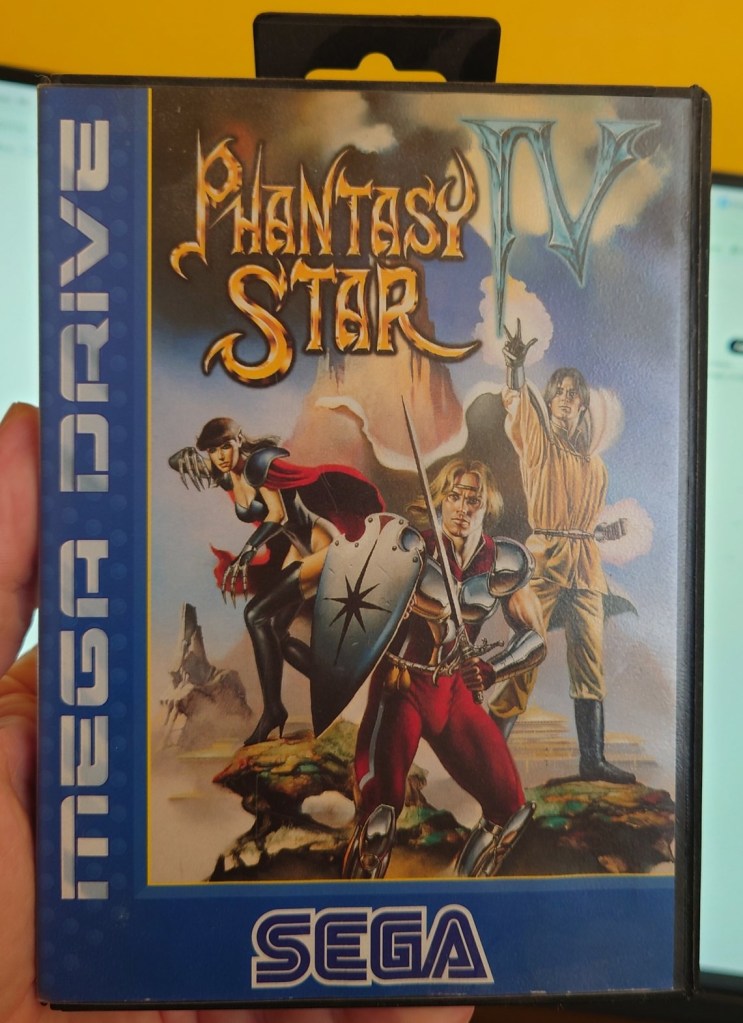
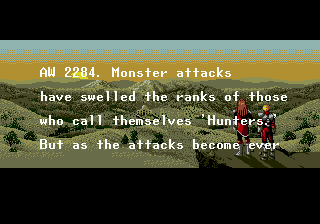
So back to that toy shop. We bought stuff there every now and then. I don’t actually have very fond memories of it. I don’t know why. I don’t really have fond memories of any of the toy stores from that era, like I have fond memories of the bookstore downtown where I later bought most of my videogames. But one day I walked into that store and on a rack on the right side of the room they had Phantasy Star IV. I don’t know what it was about this game, but it immediately drew my attention. It seemed to be exactly what I was yearning for, even though I couldn’t exactly articulate why.
I don’t know how much I knew about genres back then. I probably knew what an RPG was, although not everything you could find under that category felt like what I wanted. Golvellius: Valley of Doom had seemed like exactly what I was looking for, but it had been confusing and disappointing, despite my many attempts to get better at it.
I said that I yearned for something, and I chose that verb deliberately. I really did yearn. There was something that computer games could provide that I desperately wanted. It was similar to what I was hoping to find in certain books or TV shows or movies, and sometimes (rarely) did. A feeling that I couldn’t put into words, but which seemed incredibly important.
Despite the fact that the game was outrageously expensive (24900 drachmas, which is about 80 dollars/euros, except money was actually worth far more back then) I somehow ended up owning this game. I don’t remember who bought it for me and when, but I do remember playing it for the first time.
The game didn’t need more than its intro to totally hook me. That mysterious music (I can hear the melody right now!), that feeling of having embarked on a huge adventure, and of course that image you see there, of a wide landscape before you, beckoning you… that’s what the magic of games meant to me. That’s what I wanted. To be transported into another world.
Not systems, not replayability, not stats or achievements or features. Another world.
Phantasy Star IV didn’t disappoint. In fact, it spoiled me. Its world is so huge that it makes every modern-day RPG look paltry, and it’s full of people, too, all of them with little nuggets of story. Speaking of story, its narrative builds and builds to a massive climax, only to reveal that what you’ve just experienced is really just the introduction to a much wider cosmic struggle that takes the game from post-apocalyptic fantasy to full-on science fiction. It’s truly an epic.
What characterizes most of the games that I really responded to is their commitment to the idea of creating something that is both world and story. The attention paid to all the various NPCs and the way their dialogue changes all throughout the game. The little scenes and character moments that aren’t relevant to the plot but exist simply because they belong in the world. The way everything you do is structured by the in-game fiction: going to your headquarters to pick up missions, for example. The sense of history that pervades every location, which is even more powerful if you’ve played the other Phantasy Star games.
Being the last in series set across thousands of years, Phantasy Star IV features a theme that I responded to powerfully and which still resonates in all of my own writing: the inescapable reality, power, and tragedy of time. Another Mega Drive favourite, Soleil (aka Crusader of Centy) also took that theme surprisingly seriously, and it’s likewise present in so many of the books that I obsessively devoured, from Tolkien’s Lord of the Rings to Asimov’s Foundation to Eddings’ lesser but still essential to my experience Belgarath the Sorcerer. From my earliest days, I remember being aware that I had been born into a particular point in time, and that my life would form one small thread in a much bigger tapestry.
Growing up in an ancient city surrounded by buildings from Classical, Byzantine, and Ottoman times no doubt helped strengthen that awareness, as did my early exposure to Carl Sagan’s Cosmos. The special thing about games, however, is that they create worlds, and those worlds can allow you to experience the power of time in unique ways. In Soleil, for example, there are moments when you travel into the past, seeing the same places at a different point in their history, and those sequences are genuinely quite haunting. Doubly so when you return to the present, when you walk the same roads again with different eyes, when you are suddenly the only one who remembers the tragedies of the past, or you’re suddenly aware that some of the stories you’ve been taught are actually lies.
(Would those sequences be less haunting to me today? Yes, because I’m an adult and some of these games are for children. There’s no shame in that. That doesn’t make them worthless! And some of the power does remain even when you’re older, because these are works of real artistic intent.)
Nowadays there are many who see games purely as products, as lists of features. And I don’t just mean publishers or developers; there are players, too, who demand that games never stray from what’s expected. People who find themselves furious, for example, that The Talos Principle 2 is not an exact copy of its predecessor with new puzzles. Who cannot stand that it’s not about wandering around lonely environments with a voice in your head and occasionally stopping to argue with a computer, because to them that’s the product, and the sequel should be more of the product. (If you liked a candy bar and wanted another candy bar, you’d be disappointed if the second candy bar was different.) Who think that the ways in which Talos 2 is different are an attempt to “improve” the franchise, to add features to a product, and not a set of deliberate choices made in an effort to create that unique magic of games. To serve the reality of the world and the story, or rather the world as story, the story as world.
Honestly, that’s all I care about in this medium.
The logic of making products would lead to a Talos 2 that’s the same thing again, but with a different coat of paint and some additions. (I saw one user speculating that we’d go back and make Talos Reawakened be exactly like Talos 2, and that’s a perfect demonstration of this logic, and how following it will also make you incapable of understanding or enjoying Talos 2.) The logic of treating games as both world and story leads you to a game where the events of Talos are paid off, where a whole city of people exists even though it is in no way necessary for gameplay. It leads to mapping out the details of that society, building a whole message board that evolves as the game progresses, creating art and poetry for this new culture, making it rich with humanity. And in the process creating those experiences which have been the most meaningful to me, in which people connected with this material that would otherwise never have existed.
None of that’s necessary. None of that’s what making a product requires, because a product does not require its world to have dignity, its characters to have grace, to have a richness that goes beyond the strict needs of the product. I don’t think the magic is possible otherwise, though. At least not the kind of magic that I care about. Let’s not forget there were plenty of people who thought the first Talos Principle didn’t need all that unnecessary story stuff either. That’s not the product.
There are other joys to be had in games, for sure. There’s the fun of goofing around with friends in multiplayer, which can enormous, there’s the more mind-numbing but addictive quality of games designed to be played over and over, and so on. There are games that are more like toys, games that are more like spreadsheets, games that are more like experiments – games aren’t really any one thing, and that’s fine. But none of that other stuff terribly matters to me personally. If that’s all that games could ever be, I’d stop making games tomorrow.
And believe me, I have many days when I’m tempted. Those people who insist that everything should be a product wear me down. I don’t have the strength that I used to. Sometimes I think let them have it, let everything become like the Star Wars sequel trilogy, an endless postmodern regurgitation. Walk away. There are other media that I love working in, it was never exclusively about games for me.
The only thing that’s really kept me going in this industry is wanting to create that same sense of wonder for other people, and not just for kids. Without being arrogant, I think it’s possible to make satisfying, meaningful games for an adult audience, games with the philosophical and literary depth of any other form of art. Crucially, I don’t see this as doing something that breaks with what games have been, or that’s meant for a non-gaming audience. I think highly of those games which shaped me, which let me experience that magic. I wouldn’t be doing this without them. I just think it’s possible to learn from what they did and go farther.
These are just some late-night rambling thoughts, triggered by remembering an old game and the long-gone version of Greece I experienced it in. Sometimes I think I’ve strayed very far from that kid who fell in love with the magic of games. I’ve seen too much of how the sausage is made, fought and lost too many battles to try and preserve the integrity of an experience that quite a lot of people either don’t care about or find downright offensive. But every now and then I’m reminded that the magic is still possible, so long as you stop thinking of games as mere products.
P.S. But aren’t games products, created by a capitalist economy for corporations to make money? Of course they are. And as game developers, we often have to find ways of working within that framework. But why should we allow this dehumanizing, crude corporate language to infiltrate the way we think about the experience itself? And why should players, who have the chance to experience that incredible magic with fresh eyes, be encouraged to spoil it for themselves? No normal human being should use the term “intellectual property” in everyday life, and none of us should let degenerate corporate ways of thinking corrupt our love of art.
You may have noticed that I’ve pretty much disappeared from the internet. I used to write all the time, both here and on social media. Quite a few people used to read my blog, and I did my best to engage with the political and philosophical issues that I thought I had something useful to say about. But gradually I just vanished.
It’s not just down to one thing, but to a combination of factors.
The internet changed drastically over the last decade. It became totally colonized by large corporations, erupted into idiotic culture wars, and then collapsed into a hellscape of sociopathy and slop. Spending any time on the internet now is intensely depressing to me. There’s too much to say about this transformation to fit here, but it’s certainly made me want to retreat, if only because interacting with it at all drains me and leaves me despondent.
Speaking of depression – I’ve grown extremely suspicious of the internet’s tendency to incentivize sharing one’s trauma, so I won’t go into detail, but I can say that the last ten years have been very rough for me personally. There have been great moments and accomplishments I’m proud of, like all my work on the Talos games, or working for ACE Team, or making Gospels of the Flood, but the lows have been very low. A lot of it is things outside my control: bad things happening to people I love, the random disasters of everyday life – and it’s certainly not been helped by living in a collapsing culture and a terminally broken political system.
I have not yet found a way of truly putting into words how it feels to work so hard, to try and do everything right, to be everything to everyone, and to find out that in the blink of an eye, you went from twenty-something to forty-something. I caused physical and mental damage to myself trying to bring a level of quality to projects that… well, they just weren’t worth it. The sheers hours I worked, let alone the amount of mental energy that went into some of this stuff! But I wanted the games to be good, I wanted someone who sees my name on a project to know I didn’t phone it in.
As a consequence of all this I also got more and more stressed about not completing the game I crowdsourced all those years ago, The Council of Crows. I poured tons and tons of work into it, but it kept getting bigger and harder to manage, and the gaps in my ability to work due to other commitments or (increasingly) due to illness made it harder to keep track of what still needed to be done. But things kept getting in the way, and some of them were the kind of things you can’t really negotiate with.
I cannot stress enough how unhappy this has made me. Normally I deliver everything on time, and here is my own project and I’m more than a decade late with it. And every time I think I’m almost done, something else goes wrong. (For those keeping track, I’ve recently released an update that includes all the previous Lands of Dream games, with various improvements, which should be the final step to releasing The Council of Crows.)
In 2025, apart from struggling with the death of a beloved cat that hit me harder than almost anything ever has, I developed major issues with my shoulders, likely due to too many years of nonstop writing. That’s on top of ongoing severe problems with my left knee. And I also got the world’s most miserable flu which wiped out almost a month of work. So I’m still not quite where I wanted to be.
But with the update I mentioned above, I’m close to finally getting this burden off my back, and you cannot imagine how much good that will do me. It won’t make me feel less guilty for taking so long, but at least it will finally be done, and I will feel ready to move on to other things. Because honestly, I want to come back. I want to write again, to share ideas. I have a new audio drama coming out soon, and new projects that will be announced, and I just want to be participating in the world again, even if it is this hellscape. If I can contribute some small element to the creation of a counterculture that’s opposed to this horrible misanthropic garbage we’re all drowning in, that would be worth the frustrations of dealing with the modern internet.
I have so many ideas. So many stories still in need of telling. I somehow spent my entire thirties without telling almost any of them, and that’s a failure I deeply regret. I have enough sympathy for my past self to understand why those choices seemed correct, even unavoidable, but I think in the long term they were wrong, and I’m going to try to make different choices now.
So please keep an eye out for me. I do still want to finish The Council of Crows before I do anything like creating a Patreon, because it feels wrong to ask for money (even if it will go solely towards making things, not to paying bills) without having delivered on that front. But I’m slowly getting out of this miserable state that I’ve been in, and I think in 2026 I’ll have a lot of new stories for you. If you like what I do, please just hold on a little longer. I’m coming back.
 Jonas Kyratzes