Recently I was reminiscing about a foundational experience of my life as a game developer. I don’t know how old I was, but I’m guessing it was somewhere between 11 and 13. My family did not have a PC yet, but we had a Sega Mega Drive, relatively recently purchased. I also had a Gameboy, which had already provided some life-changing experiences (Metroid II and Link’s Awakening), and a Sega Master System, which had some memorable games but never quite what I was longing for.
There had been a moment of agonizing about whether to get a SNES or a Mega Drive (aka Genesis) – and writing this, I just realized that the agony of this dilemma has caused the location of the shop where my dad bought me the console to be imprinted on my brain. It was in Kalamaria, near my orthodontist who gradually went from very attentive to letting his less skillful assistant/wife do everything, until one day we stopped going and my teeth never got fixed. And now I’m remembering the time the assistant/wife accidentally broke my braces, and the weird sensation of that stuff they put in your mouth to take a mould. Memory’s funny that way.
Anyway, there was a shop not too far from where we lived, maybe twenty minutes away, on a street called Anatolikis Thrakis (Eastern Thrace Street), near where I would later have Tae Kwon Do lessons. This was a toy shop, not a videogame shop. I don’t think we had videogame shops, at least not that I knew of.
Another memory just surfaced. On the way to that shop, opposite a carousel that probably every child who lived in that area in the 80s or 90s remembers, there was a shop on the corner that sold… I’m not sure what exactly, but it included a handful of Gameboy cartridges. There was one game I really wanted, which I thought was something I had read about in a game magazine, although it’s entirely possible I’d just misunderstood what it was, conflated two different games. Back then it was hard to really understand what anything was. You got snatches of information from other kids at school, you read magazines which often were out of date, and in my case most of it just confused you. Anyway, that game sounded like it might be amazing, but I never bought it, and I don’t remember what it was, although I still get a kind of indescribable vibe of what it might have been. Something sidescrolling to do with robots.
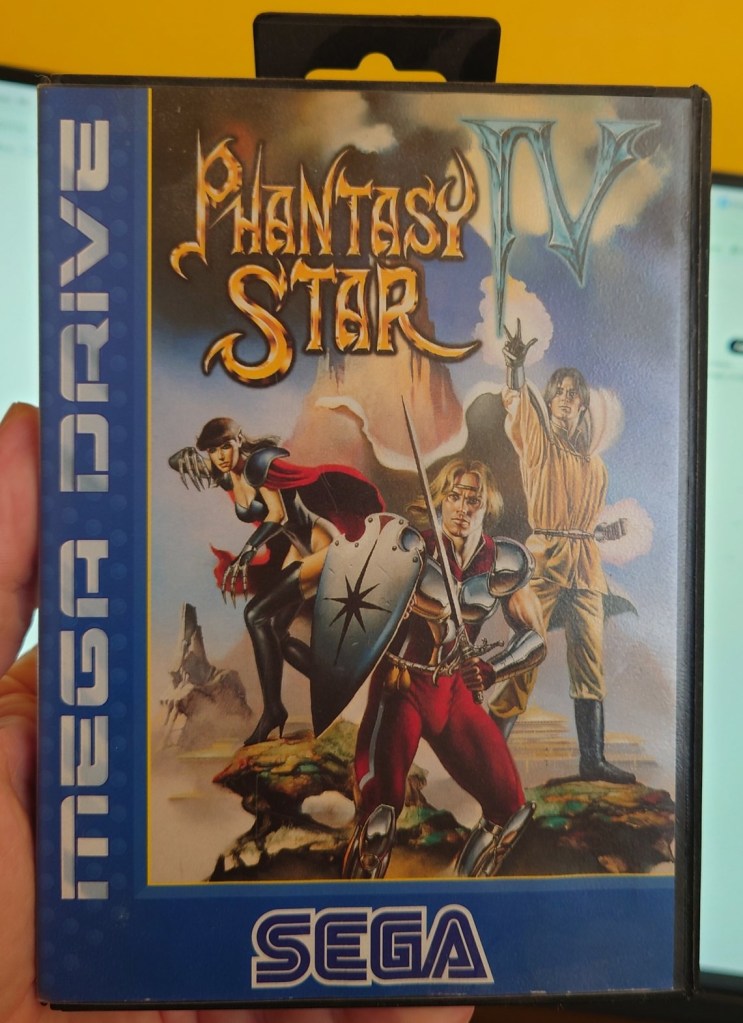
So back to that toy shop. We bought stuff there every now and then. I don’t actually have very fond memories of it. I don’t know why. I don’t really have fond memories of any of the toy stores from that era, like I have fond memories of the bookstore downtown where I later bought most of my videogames. But one day I walked into that store and on a rack on the right side of the room they had Phantasy Star IV. I don’t know what it was about this game, but it immediately drew my attention. It seemed to be exactly what I was yearning for, even though I couldn’t exactly articulate why.
I don’t know how much I knew about genres back then. I probably knew what an RPG was, although not everything you could find under that category felt like what I wanted. Golvellius: Valley of Doom had seemed like exactly what I was looking for, but it had been confusing and disappointing, despite my many attempts to get better at it.
I said that I yearned for something, and I chose that verb deliberately. I really did yearn. There was something that computer games could provide that I desperately wanted. It was similar to what I was hoping to find in certain books or TV shows or movies, and sometimes (rarely) did. A feeling that I couldn’t put into words, but which seemed incredibly important.
Despite the fact that the game was outrageously expensive (24900 drachmas, which is about 80 dollars/euros, except money was actually worth far more back then) I somehow ended up owning this game. I don’t remember who bought it for me and when, but I do remember playing it for the first time.
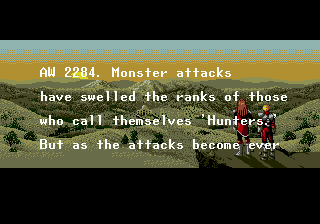
The game didn’t need more than its intro to totally hook me. That mysterious music (I can hear the melody right now!), that feeling of having embarked on a huge adventure, and of course that image you see there, of a wide landscape before you, beckoning you… that’s what the magic of games meant to me. That’s what I wanted. To be transported into another world.
Not systems, not replayability, not stats or achievements or features. Another world.
Phantasy Star IV didn’t disappoint. In fact, it spoiled me. Its world is so huge that it makes every modern-day RPG look paltry, and it’s full of people, too, all of them with little nuggets of story. Speaking of story, its narrative builds and builds to a massive climax, only to reveal that what you’ve just experienced is really just the introduction to a much wider cosmic struggle that takes the game from post-apocalyptic fantasy to full-on science fiction. It’s truly an epic.
What characterizes most of the games that I really responded to is their commitment to the idea of creating something that is both world and story. The attention paid to all the various NPCs and the way their dialogue changes all throughout the game. The little scenes and character moments that aren’t relevant to the plot but exist simply because they belong in the world. The way everything you do is structured by the in-game fiction: going to your headquarters to pick up missions, for example. The sense of history that pervades every location, which is even more powerful if you’ve played the other Phantasy Star games.
Being the last in series set across thousands of years, Phantasy Star IV features a theme that I responded to powerfully and which still resonates in all of my own writing: the inescapable reality, power, and tragedy of time. Another Mega Drive favourite, Soleil (aka Crusader of Centy) also took that theme surprisingly seriously, and it’s likewise present in so many of the books that I obsessively devoured, from Tolkien’s Lord of the Rings to Asimov’s Foundation to Eddings’ lesser but still essential to my experience Belgarath the Sorcerer. From my earliest days, I remember being aware that I had been born into a particular point in time, and that my life would form one small thread in a much bigger tapestry.
Growing up in an ancient city surrounded by buildings from Classical, Byzantine, and Ottoman times no doubt helped strengthen that awareness, as did my early exposure to Carl Sagan’s Cosmos. The special thing about games, however, is that they create worlds, and those worlds can allow you to experience the power of time in unique ways. In Soleil, for example, there are moments when you travel into the past, seeing the same places at a different point in their history, and those sequences are genuinely quite haunting. Doubly so when you return to the present, when you walk the same roads again with different eyes, when you are suddenly the only one who remembers the tragedies of the past, or you’re suddenly aware that some of the stories you’ve been taught are actually lies.
(Would those sequences be less haunting to me today? Yes, because I’m an adult and some of these games are for children. There’s no shame in that. That doesn’t make them worthless! And some of the power does remain even when you’re older, because these are works of real artistic intent.)
Nowadays there are many who see games purely as products, as lists of features. And I don’t just mean publishers or developers; there are players, too, who demand that games never stray from what’s expected. People who find themselves furious, for example, that The Talos Principle 2 is not an exact copy of its predecessor with new puzzles. Who cannot stand that it’s not about wandering around lonely environments with a voice in your head and occasionally stopping to argue with a computer, because to them that’s the product, and the sequel should be more of the product. (If you liked a candy bar and wanted another candy bar, you’d be disappointed if the second candy bar was different.) Who think that the ways in which Talos 2 is different are an attempt to “improve” the franchise, to add features to a product, and not a set of deliberate choices made in an effort to create that unique magic of games. To serve the reality of the world and the story, or rather the world as story, the story as world.
Honestly, that’s all I care about in this medium.
The logic of making products would lead to a Talos 2 that’s the same thing again, but with a different coat of paint and some additions. (I saw one user speculating that we’d go back and make Talos Reawakened be exactly like Talos 2, and that’s a perfect demonstration of this logic, and how following it will also make you incapable of understanding or enjoying Talos 2.) The logic of treating games as both world and story leads you to a game where the events of Talos are paid off, where a whole city of people exists even though it is in no way necessary for gameplay. It leads to mapping out the details of that society, building a whole message board that evolves as the game progresses, creating art and poetry for this new culture, making it rich with humanity. And in the process creating those experiences which have been the most meaningful to me, in which people connected with this material that would otherwise never have existed.
None of that’s necessary. None of that’s what making a product requires, because a product does not require its world to have dignity, its characters to have grace, to have a richness that goes beyond the strict needs of the product. I don’t think the magic is possible otherwise, though. At least not the kind of magic that I care about. Let’s not forget there were plenty of people who thought the first Talos Principle didn’t need all that unnecessary story stuff either. That’s not the product.
There are other joys to be had in games, for sure. There’s the fun of goofing around with friends in multiplayer, which can enormous, there’s the more mind-numbing but addictive quality of games designed to be played over and over, and so on. There are games that are more like toys, games that are more like spreadsheets, games that are more like experiments – games aren’t really any one thing, and that’s fine. But none of that other stuff terribly matters to me personally. If that’s all that games could ever be, I’d stop making games tomorrow.
And believe me, I have many days when I’m tempted. Those people who insist that everything should be a product wear me down. I don’t have the strength that I used to. Sometimes I think let them have it, let everything become like the Star Wars sequel trilogy, an endless postmodern regurgitation. Walk away. There are other media that I love working in, it was never exclusively about games for me.
The only thing that’s really kept me going in this industry is wanting to create that same sense of wonder for other people, and not just for kids. Without being arrogant, I think it’s possible to make satisfying, meaningful games for an adult audience, games with the philosophical and literary depth of any other form of art. Crucially, I don’t see this as doing something that breaks with what games have been, or that’s meant for a non-gaming audience. I think highly of those games which shaped me, which let me experience that magic. I wouldn’t be doing this without them. I just think it’s possible to learn from what they did and go farther.
These are just some late-night rambling thoughts, triggered by remembering an old game and the long-gone version of Greece I experienced it in. Sometimes I think I’ve strayed very far from that kid who fell in love with the magic of games. I’ve seen too much of how the sausage is made, fought and lost too many battles to try and preserve the integrity of an experience that quite a lot of people either don’t care about or find downright offensive. But every now and then I’m reminded that the magic is still possible, so long as you stop thinking of games as mere products.
P.S. But aren’t games products, created by a capitalist economy for corporations to make money? Of course they are. And as game developers, we often have to find ways of working within that framework. But why should we allow this dehumanizing, crude corporate language to infiltrate the way we think about the experience itself? And why should players, who have the chance to experience that incredible magic with fresh eyes, be encouraged to spoil it for themselves? No normal human being should use the term “intellectual property” in everyday life, and none of us should let degenerate corporate ways of thinking corrupt our love of art.
 Jonas Kyratzes